


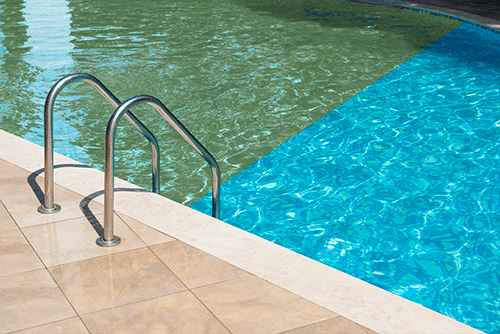
You have just treated your pool with chlorine and the water has suddenly turned brown, red, translucent green or even black.
It is important to treat it quickly if you do not want this discolouration to stick and leave indelible stains on your pool lining.
Why has my pool water turned brown, translucent green, reddish or black?
Corrosion:
Metal parts of the pool, such as ladders, railings, or other old pipes, exposed to unbalanced water pH, especially if it is below 7.0, i.e. acidic, promote the process of corrosion and dissolution of metal ions.
Attacked by chlorine (but also other types of disinfectants such as bromine or active oxygen), oxidised metal particles will colour the water and may also stain the pool lining.
Drilled or well water:
If you fill your pool with water from a borehole or well, it is highly likely that this water contains copper, iron or manganese.
Using this type of water to fill your pool can cause the colour of your pool to change to brown (iron), translucent green (copper), reddish or black (iron or manganese).
Caution: some anti-algae products contain copper, which can also cause water discolouration.
Well water is generally harder than mains water, containing more minerals, sulphur and other metals. This can make it very difficult to balance the pool water.
What are the risks?
Although it does not pose a major health risk, it is best to stop swimming. This reaction can damage your facilities and equipment.
You must act quickly, as some stains caused by the discolouration of the water may become permanent.
Treatment advice for discoloured water:
Identify the problem:
It is important not to confuse:
- opaque green water, usually caused by algae growth
- yellow water resulting from the presence of mustard algae
- cloudy water, which is a sign of limescale or a filtration problem
- if the water is coloured in brown, reddish or black and the phenomenon intensifies on contact with disinfectant, then you are dealing with metals
Addressing the problem:
Start by having the pool water tested by a pool specialist, if possible, to confirm the diagnosis.
- If necessary, adjust the pH between 7.0 and 7.4 using HTH pH MINUS micro-balls to lower the pH or if you need to raise it, using HTH pH PLUS powder.

with handle and dosing cap
- Use HTH METALSTOP metal sequestrant to prevent dissolved metals from forming scale, at a rate of 400 ml per 10 m³ of water.
- Stop filtering the pool after it has been completely filtered.
- Perform static flocculation with HTH RAPIDFLOC, leaving it to act for 12 to 24 hours.
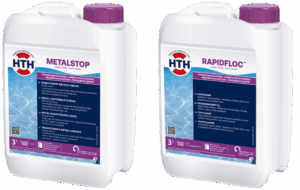
HTH RAPIDFLOC
- Then vacuum up any deposits that have accumulated at the bottom of the pool with a vacuum cleaner and send the dirt down the drain.
- Restart the filtration system.
Now you’ve got rid of your discoloured water. However, you should keep an eye on your pool water because if this phenomenon is caused by mains water or well water, it may reappear.


