


Over-stabilised water
Summer is already well underway: you opened your pool in April or May and have been enjoying it ever since with your children and friends…
You treated your pool regularly—one chlorine tablet per week, a shock treatment every 15 days, a little clarifier… everything had been going well so far.
And yet… in June or July, your pool turns green and algae start to develop!
You carry out a shock treatment, add algaecide… nothing works—your water stays green.
At this point, there is probably no other solution than to drain your pool water. The kids are impatient, your friends are disappointed… no swimming this weekend!
What is over-stabilisation?
Pool stabiliser is cyanuric acid.
It is present in so-called “standard” chlorine products and helps limit the breakdown of chlorine under the effect of sunlight. It protects the chlorine so that it remains active for as long as possible without degrading.
However, this stabiliser does not evaporate or disappear from the water: it accumulates, remains in the pool, and eventually prevents chlorine from performing its disinfecting action.
When a certain amount of stabilised chlorine has been used over the course of the season, the stabiliser therefore builds up in excessive quantities in the water. As a result, the disinfecting action of chlorine molecules is slowed down or even “blocked,” allowing microorganisms to proliferate. The water turns green and becomes unbalanced.
This is the phenomenon known as over-stabilisation, also called chlorine lock. Bacteria then multiply faster than the chlorine can act to destroy them.
If stabilised chlorine is added at this point, the problem is made worse rather than solved, since it further increases the amount of stabiliser. As a reminder, stabiliser does not disappear—it always remains in the water.
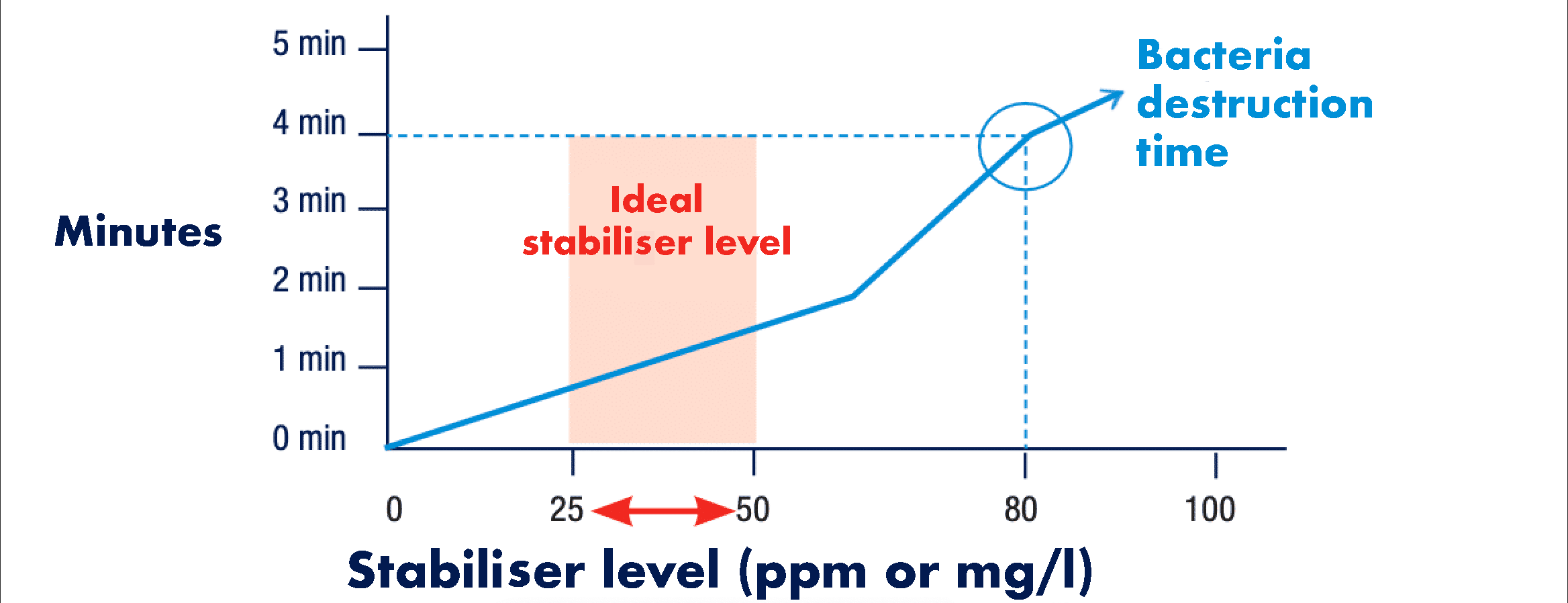
A “standard” 200 g slow-dissolving stabilised chlorine tablet releases approximately 100 g of cyanuric acid (stabiliser) into the pool. A 50 m³ pool treated with 200 g stabilised chlorine tablets becomes over-stabilised after just 5 months!
How can you recognize an over-stabilised pool?
The water “turns” and becomes green as algae develop, since the chlorine no longer destroys them.
It should be noted that the water is no longer disinfecting, meaning that viruses and fungi present in the water are no longer properly eliminated and begin to multiply. In short, this is a pool you certainly wouldn’t want your children swimming in!

➽ How can you fix over-stabilised pool water?
The only solution is to get rid of the excess stabiliser by partially draining the pool water and replacing it with fresh water. This solution is restrictive during peak season and costly.
It is then advisable to use a non-stabilised chlorine, such as the HTH red range, as a preventive measure in order to avoid over-stabilising your pool water (see below).
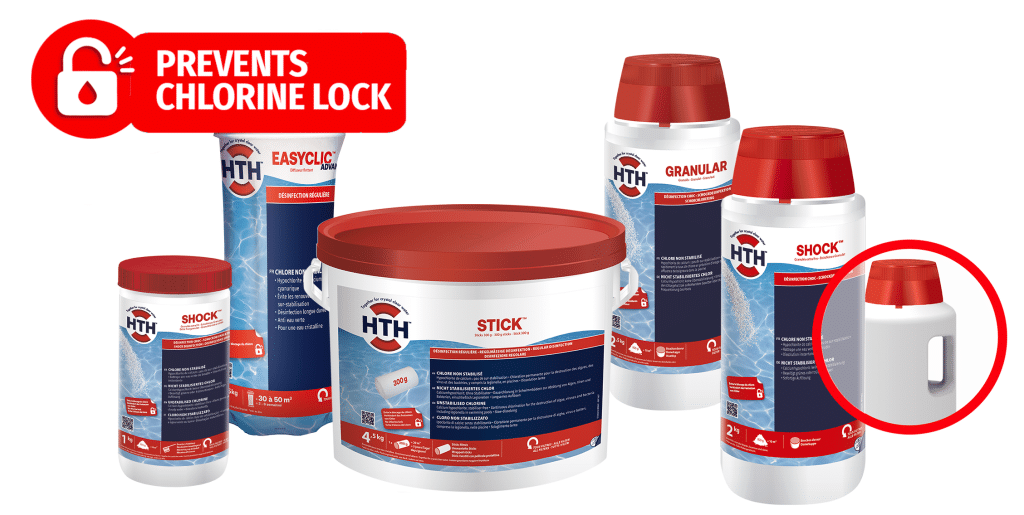
By using non-stabilised chlorine, you can control the amount of stabiliser you add yourself.
It is recommended to measure the stabiliser level in your pool water every 6 months and keep it between 30 and 50 ppm (or mg/L).

In summary, how can over-stabilisation be avoided?
- By regularly checking the stabiliser level in the water. We recommend maintaining a stabiliser level between 30 and 50 ppm*.
- By using non-stabilised chlorine (calcium hypochlorite – HTH red range).
- Especially if your pool is indoors, as without UV exposure, stabiliser is not necessary.
- If your pool is outdoors, we recommend adding only the required amount of stabiliser.
* Standard recommended by the Regional Health Agency for commercial pools.
DO NOT MIX CALCIUM HYPOCHLORITE WITH ANY OTHER TREATMENT PRODUCT.
NEVER DISSOLVE BEFORE USE.
USE BIOCIDAL PRODUCTS WITH CARE.
BEFORE ANY USE, READ THE LABEL AND THE PRODUCT INFORMATION CAREFULLY.


