


The problem
Algae in swimming pools can be quickly identified, as they discolor the water in various shades (green, yellow, pink, or even brown). Some types of algae also tend to make pool surfaces slimy and slippery due to the formation of a biofilm.
Algae growth results from a combination of several factors.
- Water temperature plays an important role in the growth of microorganisms.
- Exposure to light—and therefore sunlight—accelerates photosynthesis, which drives algae growth.
- Acting as true nutrients, phosphates serve as a fertiliser for algae and actively contribute to their development. Phosphates originate from all living organisms and are found in top-up water, rain, urine, all types of plant debris, and even fertilisers used near the pool.
Be careful: when algae die, they release phosphates, which in turn feed algae growth—even in the presence of chlorine.
It is therefore important to identify them correctly and treat the water quickly in order to stop their development and eliminate them.
There are different types of algae—how can you recognise them and choose the appropriate treatment?
The different types of pool algae
- Green algae: These are the easiest to identify—your pool water turns green. They have a slimy, slippery texture that makes the pool walls and floor slippery.
- Black algae: Small black spots appear on the pool walls, floor, or in the grout of tiled pools. They are very resistant, so be sure to remove the algae down to the root.
- Mustard algae: Their fine, airborne appearance can resemble yellow pollen or dust. They mainly develop in the least sunlit areas of the pool.
The solutions
Against green algae:
To treat green algae, adjust the pH to between7.0 and 7.4, carry out a shock treatment, then use the HTH HTH KLERAL or HTH SUPER KLERAL. To prevent their proliferation, it is important to carry out a complete water analysis with your authorised dealer in order to identify the cause of their development: excessive phosphate levels? over-stabilisation?

Against black algae:
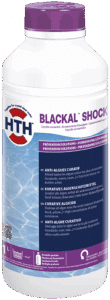
To treat black algae, brush the pool floor and walls, adjust the pH to between 7.0 and 7.4, then add the product HTH BLACKAL SHOCK.
Against mustard algae (and other resistant algae):
To treat mustard algae, adjust the pH to between 7.0 and 7.4, then use HTH YELLOW SHOCK.

Flocculation process:
Then use the flocculant HTH 𝗥𝗔𝗣𝗜𝗗𝗙𝗟𝗢𝗖 liquid. (Check beforehand that the product is compatible with your filtration system.)
Why should you flocculate your pool water?
➽ Flocculant helps clarify the water by grouping fine particles and settling them at the bottom of the pool.

Once these impurities have settled on the bottom of the pool, remove them using a vacuum head, sending them directly to waste without passing through the filter (multiport valve set to the “waste” position).
Mustard algae, also known as yellow algae, looks like very fine, highly volatile yellow dust that mainly settles on the pool walls and especially on the bottom.
When you try to vacuum it, the dust disperses, forming a sharp yellow cloud, but it settles again after a few minutes once the water becomes calm.
The appearance of mustard algae is rarely an isolated case and often occurs by geographic area. If your pool is affected, your neighbor’s pool is likely to be affected as well—and vice versa.
In a nutshell:
Keeping the disinfectant level properly balanced and ensuring good filtration are key to preventing algae.
- Make sure the filter is not clogged.
- Clean the filter regularly.
- Adjust the filtration time according to pool usage and water temperature.
Finally, it is strongly recommended to clean all objects that may have come into contact with algae, such as inflatable mattresses, toys, and other pool floats. Also clean the vacuum head or robotic cleaner used to remove the particles. Without these simple precautions, algae are likely to return regularly.
USE BIOCIDAL PRODUCTS WITH CAUTION. BEFORE USING, READ THE LABEL AND THE INFORMATION ABOUT THE PRODUCT.


