


For proper treatment of your hot tub water, you should monitor the following:
- Water balance: optimises bathing comfort and the effectiveness of disinfectants.
- Water disinfection: a regular disinfection will prevent the growth of microbes, fungi and bacteria.
- Filtration: will help remove micro-organisms and polluting particles.
There are several types of spa water treatments: chlorine, bromine or active oxygen. Bromine is particularly recommended for spa treatments as it remains effective even in hot water and at high pH levels.
Water balance
Water pH
The pH level determines the acidity or alkalinity of your spa water.
This can change very quickly and cause discomfort for bathers. Balancing the water is essential for your bathing comfort, but also to limit limescale deposits and corrosion of equipment.
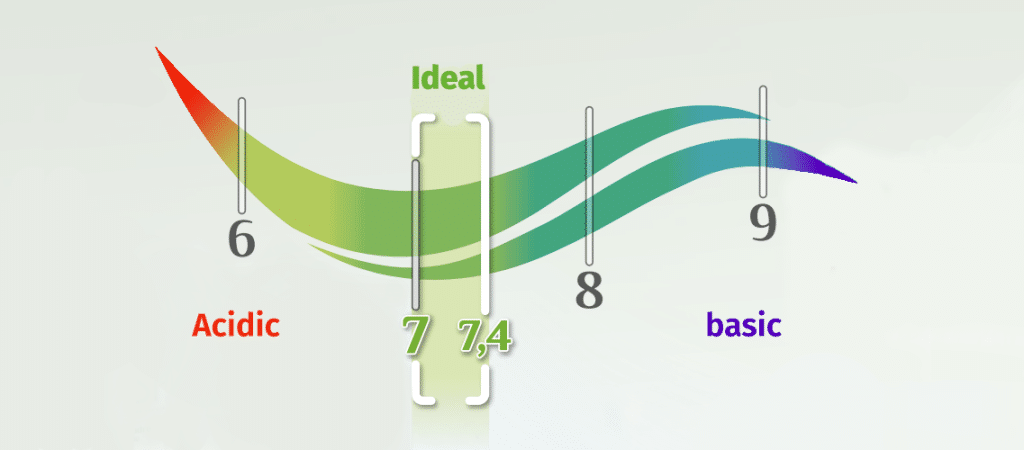
If the pH is ACIDIC,
there is a risk of:
If the pH is too BASIC,
there is a risk of:
- Corrosion of the spa and equipment
- Rapid deterioration of the shell and rubber seals
- Discomfort for bathers (irritation, odours, etc.)
- Increase in treatment costs
- Limescale deposits on the shell and pipes
- Increase in treatment costs
- Cloudy or milky water
- Eye and skin irritation
The ideal pH is between 7.0 and 7.4.
7.4 is also the pH of tears, blood and mucous membranes in the human body.
That is why it is necessary to check and monitor the pH of your spa frequently.
If your pH is not between 7.0 and 7.4, it is essential to adjust it. A balanced pH will facilitate the action of disinfectants and other treatment products designed to work optimally at a neutral pH (closest to 7).
To increase it, use HTH spa pH PLUS and to lower it HTH spa pH MINUS


Two other parameters can improve water quality: alkalinity and water hardness. These measures should be carried out regularly or when a problem arises.
Water alkalinity
Alkalinity or TA (total Alkalinity) indicates the mineral salt content in water (carbonates and bicarbonates – CACO3). These act as buffers and help stabilise the acidity of the water.
Alkalinity therefore measures the water’s ability to neutralise acids and, consequently, to moderate pH variations.
The recommended value is between 80 and 120 mg/l (8°f and 12°f).
If alkalinity falls below 80 mg/l, the pH can fluctuate considerably and cause the problems mentioned above (corrosion of equipment, discomfort for bathers, etc.).
Water hardness
We also advise to test the hardness of your mains water.
Hardness measures the concentration of calcium and magnesium salts and should be between 150 and 250 mg/l.
- Indicates whether the water is “soft” or “hard“
- Hard water can cause limescale on surfaces and inside pipes
- Water that is too soft can be aggressive to metals and cause corrosion
Water disinfection
Purify the water at start-up:
Your spa has been filled with fresh water, taken directly from the mains supply. Why is additional treatment necessary?
The answer is simple: because spa water is both warm and constantly moving, it provides the ideal conditions for microbes and bacteria to proliferate. That is why we recommend following these guidelines:
Disinfect your spa water with HTH Spa CHLORINE SHOCK after filling the spa.
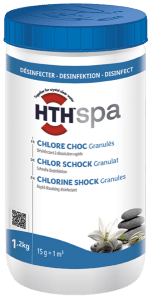
Regular disinfection:
We recommend using one of the HTH spa products from the ‘DISINFECT’ range, depending on your treatment preferences: chlorine, bromine or active oxygen.
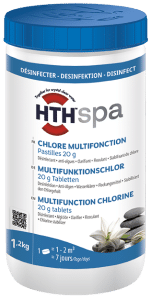

MULTI-ACTION 4
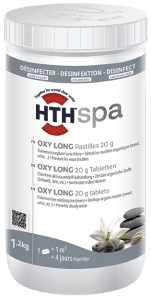
Disinfecting the water is essential for the health of spa users and for your equipment.
Choc treatment:
Regularly carry out a shock treatment using HTH spa NON CHLORINE OXY CHOC or HTH Spa CHLORINE SHOCK .
Although the water is constantly recirculated, filtered and sanitised, microorganisms capable of resisting normal levels of disinfectant can survive in the circulation system.
This creates a risk of contamination by bacteria such as Legionella.
Change the water regularly:
Drain the water from the spa according to how often it is used. If the spa is for family use only, we recommend draining it completely every two months.
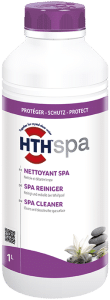
To clean the inside of the spa during periodic draining, before refilling with fresh water, use HTH spa SPA CLEANER.
Spa filtration
A well-maintained and regularly cleaned filter reduces the use of water treatment products.
Spa filtration consists of two main components:
- The pump, which ensures water circulation throughout the entire system.
- The filter, which removes small particles that could cloud the water.
It is important to follow the spa manufacturer’s instructions regarding the recommended pump operating time.
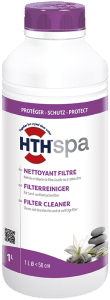
Regardless of the type of spa filtration system (sand filter or cartridge filter), it is strongly recommended that both be cleaned and descaled approximately three times a year, depending on frequency of use.
To do this, use HTH spa FILTER CLEANER with powerful detergent properties (to remove grease) and also designed to combat limescale deposits.
This step is essential for removing tiny particles that could cloud the water.
In conclusion:
By regularly following these few maintenance steps, you can ensure that you enjoy a clean, safe and pleasant spa all year round. Regular maintenance not only extends the life of your equipment, but also guarantees an optimal relaxation experience every time you use it.
Take care of your spa, and it will take care of you!
USE BIOCIDAL PRODUCTS WITH CAUTION. BEFORE USING, READ THE LABEL AND THE INFORMATION ABOUT THE PRODUCT.


